
What are Peptides?

A practical guide for pet owners exploring a rapidly evolving area of medicine
Peptides are one of the most talked-about topics in both human and veterinary medicine right now, but also one of the most misunderstood. At Red Sage, we believe in helping clients understand what something is, how it works, and where the science actually stands before making decisions for their pet.
What exactly are peptides?
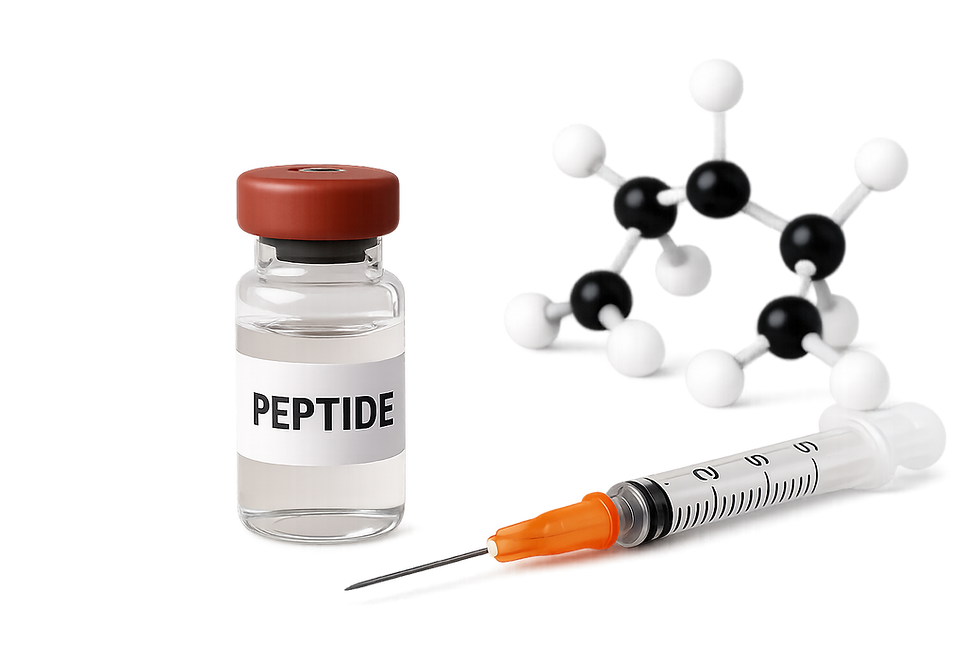
At their core, peptides are short chains of amino acids, the same building blocks that make up proteins. The main difference is size; peptides are smaller and often act more like signaling molecules than structural components.
In the body, peptides function as messengers. They help cells communicate with each other and regulate processes like:
Inflammation
Immune response
Tissue repair
Hormone signaling
Metabolism
Some peptides occur naturally in the body, while others can be synthetically produced to mimic or enhance these effects.
Why are peptides getting so much attention?
Peptides are interesting medically because they can be highly targeted. Instead of broadly affecting the entire body, many peptides interact with specific receptors or pathways, acting almost like a “key” fitting into a “lock.”
Research has shown that certain peptides can:
Support tissue healing and regeneration
Modulate inflammation
Influence immune function
Act similarly to hormones in regulating body systems
Because of this, peptides are being explored across a wide range of applications, including:
Pain management
Orthopedic and soft tissue healing
Chronic inflammatory conditions
Endocrine and metabolic disorders
Diagnostic tools and vaccines
Some peptide-based drugs have been used for decades in veterinary medicine- for example, oxytocin is a peptide hormone routinely used in large animal reproduction.
Are peptides “new” in veterinary medicine?
Not exactly. Peptides themselves are not new; the body has always used them. What’s new is the expansion of synthetic peptides and their proposed uses, especially in areas like regenerative medicine and performance optimization.
This is where things start to diverge:
Some peptides are well-studied and FDA-regulated
Others are experimental or still under investigation
And some are being marketed far ahead of the available evidence
What pet owners should know:
Peptides are not inherently “good” or “bad.” They are simply tools and like any medical tool, their safety and effectiveness depend on:
Proper dosing
Quality and purity
Appropriate patient selection
Evidence supporting their use
While early research is promising in some areas, many peptides currently discussed online do not yet have strong veterinary-specific data, especially in dogs and cats.
Our approach at Red Sage
At Red Sage, we approach peptides the same way we approach all emerging therapies:
We follow the science, not the trend
We prioritize patient safety and transparency
We evaluate evidence before recommending therapies
We collaborate with owners to make informed decisions
Peptides may absolutely play a role in the future of veterinary medicine. But right now, the key is thoughtful, evidence-based use to find the right tool for the right patient.
A note on the “grey market”
One of the biggest concerns around peptides right now is the rise of the grey market.
The grey market refers to products that are:
Not FDA-approved for veterinary or human use
Often labeled “for research purposes only”
Sold online without regulatory oversight
Not subject to standard quality, purity, or dosing verification
Unlike approved pharmaceuticals, these products may have inconsistent concentrations, contamination risks or mislabeling of ingredients.
In human medicine, the U.S. Food and Drug Administration has specifically warned that many peptide products marketed online are unapproved drugs and may pose safety risks due to lack of regulation and quality control.
For veterinary patients, this creates additional uncertainty- because even if a peptide shows promise in theory, we cannot assume safety, efficacy, or consistency without controlled studies and regulated manufacturing.
References
Bhat, Z. F., et al. “Bioactive Peptides of Animal Origin: A Review.” Journal of Food Science and Technology, vol. 52, no. 9, 2015, pp. 5377–5392.
Aguilar-Montes de Oca, S., et al. “The Use of Peptides in Veterinary Serodiagnosis of Infectious Diseases.” Veterinary Sciences, vol. 9, no. 10, 2022, p. 561.
Bachem. “Peptides in Veterinary Medicine.” Bachem, www.bachem.com/knowledge-center/peptides-in-veterinary-medicine/. Accessed 2 Apr. 2026.
Verma, A. K., et al. “Bioactive Peptides: Recent Advances and Applications.” International Journal of Molecular Sciences, 2025.
Medical News Today. “What to Know About Peptides.” Medical News Today, www.medicalnewstoday.com/articles/326701. Accessed 2 Apr. 2026.
MadBarn. “Peptides in Horses.” MadBarn, www.madbarn.com/research-topics/peptides/. Accessed 2 Apr. 2026.



Comments